Here are the results of the competition in which we asked you to create a one-page classroom activity for iT's for Teachers magazine. A big thank-you to everyone who took part in our competition to create a classroom activity for the summer issue of iT's for Teachers. We have chosen one winner and three runners-up, all of whose activities appear in the summer issue of the print magazine and at the site. The winner will receive a Papyre 6.1 e-book reader.
The competition judges were Stephanie Collins, commissioning editor for Cambridge University Press in Spain; Jamie Clement, who heads up the ELT department at Vicens Vives publishing house in Spain; Jane Cadwallader, author of infant and primary materials; Lindsay Clandfield, teacher, teacher trainer and author; and Robert Campbell, editor of iT's for Teachers.
Miniature Earth by Javier Martínez (IES La Marina, Cantabria, Spain) Students complete facts to raise their awareness on the important things in life.
Some of the judges’ comments: “I really like the idea behind this text and project and think it makes for a very interesting and original class idea. Many teachers would really like to address a topic like this, and the video is a bonus.”
“The angle of this activity is original and interesting. It’s educational and critical.”
“The content is fascinating and thought-provoking. I think students would really want to know the right answers to the cloze test (how often does that happen in an ELT activity?!), and it’s a great springboard for discussion.”
“A very well-structured activity which presents the topic in a way that is likely to generate lots of opportunity for discussion and comments. It provides a good model of how YouTube can be tapped as a great resource for lessons.”
For all these reasons, “Miniature Earth” is the overall winner of the competition, and a Papyre 6.1 e-book reader is on its way to Javier Martínez (pictured here).
Sean lay on the ground in pain, with a werewolf standing over him. You see, the werewolf was chasing some people into an alley. Sean just happened to be passing with his friends and jumped in… literally. It was a bad idea. The werewolf heard Sean and swung his arm around, hitting Sean as he was in mid-air and sending him through a wall. And now the werewolf was on top of him, showing his teeth and growling. Sean gulped and started to get nervous. He couldn’t think of the spell for taking down werewolves and he had only been looking at it yesterday. The book was in his bag. Where was his bag? “What’s your name?” he asked, trying to spare himself some time before getting eaten. The werewolf hesitated, shutting his eyes. “Doreen” he said, clearly ashamed of it. Sean tried not to laugh, but found it increasingly hard and let out a loud giggle. “I’m a Stefa,” the werewolf growled, not taking his eyes off Sean. “You know what that means do you?...It means that my pack and I were trained to be the best of the best, so I would shut my mouth if I was you.”. ‘Fra…no that’s not it…Fas… no…’ Sean tried to think of the spell. While he was thinking he heard someone speak behind Doreen. “Hey big ball-o-love,” the voice said, making Doreen turn around so Sean could see who was talking. It was his friend Mitch, who was holding one of Sean’s crossbow revolvers in his hand. He had the cocky look on his face he always had and ran his free left hand through his brown hair. “Prepare to eat silver!” With that, he pulled the trigger and a small bolt shot out of the crossbow and into the werewolf’s arm, were it lodged. Doreen just looked at it and laughed. A young, tall girl with shortish brown hair leapt out from behind the wall and put her head in her hands. Her name was Onix. “That clearly wasn’t silver,” she screech at Mitch. “Are you just naturally a dumbass?” “Of course I’m a dumbass!” came the response. This distraction was what Sean needed. “Trafa maltos,” he shouted. A bright light surrounded the werewolf, who vanished into thin air. Sean stood up and brushed himself off. He looked up at Mitch and Onix who, as always, were arguing. He walked over to them and slapped Mitch on the back of the head with his hand. “You took your time, didn’t you?” he said in an annoyed tone of voice. Mitch was wearing his long, black coat, and under that was an assortment of weapons you would usually associate with an assassin…with many more weapons besides. He had on a blue shirt and black trousers. “I had to find a silver bolt, which I obviously didn’t find, and Onix was trying to open your bag of tricks…but as we all know, that thing only opens for YOU,” said Mitch. Sean looked at Onix who was holding his bag. He put out his hands and she handed it to him. “This fool told me he got a silver one,” Onix said, shooting an angry look at Mitch. “For a guy who is fast enough to be able to outrun a Meth Dragon on heat, you aren’t so fast up here.”...She tapped Mitch’s forehead with her finger, and then slapped him. “What’s with the slapping? I mean, we have nothing to worry about now that Sean has made him go bye-bye for good. Am I right?” he said, looking at Sean who opened his mouth to speak. A voice came from behind him. “That would be impossible; he would have to know the Waraca spell, and you have to be a Moon to know that,” said a boy who appeared to be in his early teens. “THAT’S the spell I was trying to remember! But NO…I sent him away to a werewolf bar four streets away instead,” Sean said while looking through his bag. He pulled out a book and started to flick through it. After a minute he stopped on a page and read it to himself. He looked at Onix and Mitch… “Got the spell…He will be back, and he will bring others.” Sean looked at the boy and smiled. “By the way, I AM a Moon.”
…to be continued…
(posted on behalf of Sean Gallagher, Third Year pupil)
We all remember that talented child called Michael Jackson singing the lyrics, numbers and musical scale in this song back in the 70s. When we talk or write about music, we frequently use syllables to refer to each note: Do-Re-Mi… However, this symbols are not universally recognized everywhere. In countries such as the USA, UK, Germany or Ireland, our partners normally use the letters from the alphabet, though starting from La. Thus, “A” stands for “La”, “B” for “Si”, “C” means “Do” and so on… But Latin and Mediterranean languages prefer the mentioned syllables. Just let me point out another funny thing about the scale: English-speaking countries use “So” for “Sol” and “Ti” for “Si”. For these reasons, the universal language of music is no longer universal when referring to translated musical terms but it keeps on being world accepted when reading a score.
An Italian monk named Guido d’Arezzo was the very first one to come up with the idea of representing the musical scale by means of symbols on a staff. At first, the notes were written on a single line. Later, a second one was added, in a different colour and as centuries went by, we came to the pentagram which we use at present. Guido’s invention was quite significant and set the first key stone to establish a system for the musical scale, thanks to which the greatest composers in history have produced their legacy. Guido lived in the 11th century. Previous civilations such as Egyptians, Romans and Greeks surely composed a lot of interesting music, but it didn’t last because of the lack of a system to keep a printed record.
Also, it was Guido the one to put the name to the notes of the musical scale that we are using currently. At that time, there was a well-known hymn to St. John which was very popular among the monks of his monastery. That hymn happened to have a peculiar structure in which each verse started with a higher pitch than the previous one. It read like this:
Ut queant laxis
Resonare fibris
Mira gestorum
Famuli tuorum
Solve polluti
Labii reatum
Sancte Ioannes.
Guido took the very first syllable of each verse to name the six notes: Ut-Re-Mi-Fa-Sol-La. Centurias later “Ut” was changad for “Do” which seems moire suitable for singing, and the 7th note was added, “Si”, which is the abbreviation of “Sante Ioanes”, the last line of the verses of the hymn. Guido’s system allowed many monks to read music, relieving the memory effort of learning long hours of Gregorian melodies. Also, intonation turned out to be easier as each pitch was identified with a specific syllable. Guido’s invention has gone through some changes and implemented centuries later but it keeps the essence up to nowadays and it is still used by millions of musicians all over the world. Probably, he would never have imagined that it might be still alive 1000 years after his death.
Just keeping the distances, Guido’s idea was similar to Julie Andrews’ approach when singing in “the sound of music”. She was the nanny teaching music and other things who was able to conquer the widower’s heart. The film was shot in English and later translated into Spanish with a funny title “Sonrisas y lágrimas (laughter and tears)”. Tradutore, traditore… as they tend to change part of the texts, especially with songs. It takes an effort to think of the translator trying to keep to the idea while trying to match the lyrics with the syllables and the melody with the difficulty ofthe suitable rhyme.
This song is a really special case since Mary (Julie Andrews) tries to explain the children the meaning of the musical scale setting very different examples. The first verse reads “Doe” in English which becomes “Don” in Spanish. Can we infer therefore that “Doe and Don” sound the same?. The differences are clear when comparing both versions, not only because of the meaning and content but also, which is worse, because of intonation and appropriateness. So, we should try to watch films not dubbed, the original soundtrack with or without subtitles, is always much richer. Let me finish with the song in both languages for you o compare:
What do Julie Andrews, Michael Jackson and italian monk Guido d'Arezzo have in common? This article intends to explain some details about the names we give to musical notes in different languages. At the moment only in spanish, but I promise to translate as soon as possible.
A-B-C ... is easy as 1-2-3 ...or simple as Do-Re-Mi A-B-C, 1-2-3, baby, you and me girl!
Todos recordamos al niño Michael Jackson cantando a las letras, los números y las notas musicales en esta canción de los años 70. Cuando hablamos o escribimos sobre música utilizamos sílabas para referirnos a cada nota: Do-re-mi,... sin embargo, estas sílabas no son universales. En países como Estados Unidos, Reino Unido. Alemania o Irlanda se utilizan más a menudo las letras del abecedario, pero empezando desde la nota La. De este modo 'A' equivale a La, 'B' es Si, 'C' es Do, y así sucesivamente hasta la 'G', que equivale a la nota Sol. En cambio en paises latinos se utilizan con más asiduidad las sílabas mencionadas. Y apuntaré otra diferencia más: los anglosajones utilizan la sílaba 'So' en lugar de 'Sol' y 'Ti' en lugar de 'Si'. De este modo, el lenguaje musical, llamado solfeo, deja de ser universal cuando lo traducimos a palabras y a sílabas, pero sigue siendolo cuando leemos una partitura.
El primero que tuvo la ocurrencia de representar las alturas musicales mediante símbolos alrededor de una línea horizontal fue un monje italiano llamado Guido d'Arezzo. En principio las notas se escribían sobre una sola línea. Más tarde se añadió una segunda, de otro color, y con el paso de los siglos se llegó al pentagrama que utilizamos hoy. El invento de Guido fue muy relevante porque puso la primera piedra para establecer un verdadero sistema de notación musical, gracias al cual conocemos las grandes obras que nos han dejado los compositores a lo largo de la historia. Guido vivió en el siglo XI. Civilizaciones anteriores a esa fecha, como Egipcios, griegos, romanos, etc. seguramente crearon mucha música interesante, pero se ha perdido para siempre porque no existía un sistema para anotarla en papel.
También fue Guido el responsable de poner nombre a las notas musicales que utilizamos hoy. Existía por aquel entonces un himno a San Juan que todos los monjes de su monasterio conocían y en el que, casualmente, cada uno de los versos empezaba en una altura superior al anterior. El himno, en latín, decía así:
Ut queant laxis Resonare fibris Mira gestorum Famuli tuorum Solve polluti Labii reatum Sancte Ioannes
Guido tomó la primera sílaba de cada verso para dar nombre a las seis notas: Ut-Re-Mi-Fa-Sol-La. Siglos después se sustituyó 'Ut' por 'Do', que es más adecuado para el canto, y se añadió la séptima nota: 'Si', que es la abreviatura de Sancte Ioannes, el último verso del himno. El sistema de Guido permitió a muchos monjes, que hasta entonces debían memorizar horas y horas de melodías gregorianas, leer la música y descansar la memoria. Además, la entonación resultaba más facil, al identificar cada altura con una sílaba. El invento de Guido ha sufrido algunas variaciones y ha sido ampliado siglos después, pero en la esencia permanece aun vivo y sigue siendo utilizado por millones de músicos en todo el mundo. Probablemente él mismo no imaginaba que 1000 años después de su muerte seguiría teniendo plena vigencia. Salvando las distancias, lo que Guido ideó con el himno a San Juan es similar a lo que Julie Andrews cantaba a los niños en la película 'Sonrisas y lágrimas'. Ella era la institutriz buena que, entre otras cosas, enseñaba música a sus pupilos, y de paso enamoraba a su padre, viudo. La película está rodada en inglés y fue traducida enteramente al español para su doblaje. El título original, 'The sound of music' fue extrañamente traducido por 'Sonrisas y lágrimas' -estas curiosas adaptaciones de los títulos son habituales en la historia del cine-. Supongo que los traductores estaban tan acostumbrados a tergiversar ciertos textos, especialmente las canciones, que no tenían muchos reparos en hacerlo también cuando no era necesario. Cuesta imaginar a los traductores afanandose por el triple reto de traducir las canciones de la película con un mínimo de fidelidad, consiguiendo al mismo tiempo que la versión traducida encaje perfectamente en las sílabas de la melodía y además con las rimas adecuadas. La canción que nos ocupa es un caso excepcionalmente complejo, porque María -el personaje de Andrews- explica a los niños el significado de cada una de las siete sílabas musicales con ejemplos diversos. Así, en el primer verso dice 'Doe, a deer, a female deer' en la versión original y 'Don, es trato de barón' en la adaptación al castellano. ¿Se puede deducir de ello que 'Doe' en inglés y 'Don' en castellano se pronuncian de manera parecida? En la versión inglesa las notas de la canción son 'doe-ray-me-far-sew-la-tea' y en la española 'don-res-mi-far-sol-la-sí'. Como todo el mundo puede observar, se pierde mucho en la versión doblada. No solo en lo que se refiere al texto y al significado, sino -quizás aun más grave- en cuanto a entonación y declamación de los actores. Así que, aunque cueste un poco, procuremos ver las películas en su versión original, con o sin subtítulos. Es mucho más enriquecedor y constructivo. Para terminar, incluyo la letra de la canción completa en su versión original y doblada. También podeis ver ambos videos a continuación.
Doe, a deer, a female deer Ray, a drop of golden sun Me, a name I call myself Far, a long, long way to run Sew, a needle pulling thread La, a note to follow Sew Tea, a drink with jam and bread That will bring us back to Do (oh-oh-oh) ---------- Don, es trato de barón. Res, selvático animal. Mi, denota posesión. Fa(r) es “lejos” en inglés. Sol, ardiente esfera es. La, al nombre es anterior. Sí, asentimiento es Y otra vez ya viene el Do.
It was great to meet up again and see what progress has been made. Pepe, your music class will be long remembered. Christian, you made a big impression in Dumfries-the Iron Man.
Here are some pictures of a few readers.
Back home, just a few words to say thank you to our Irish partners. We've enjoyed a lot our stay in that beautiful land. We've done a lot of activities, but I'd like to highlight the visit to the music classroom -really interesting for me- and the warm welcome of the teacher, Mrs. Cavanagh. At the end of the class, all the students made a superb performance of a 'a capella' three voice song. Here is an advance from our photo album. One of the pictures shows our school in a bird eye view. Is the large building in the centre. It was taken from the aeroplane, a few minutes before landing.
By the way, you can also explore the building in 3D using Google Earth. Coordenates: 43º26'41N - 3º54'04W.
Here we are in front of Carndonagh's pride and joy, the Donagh Celtic Cross. It sits just outside the school gate. Mr. Martínez informs me that it dates back to the 7th Century. (It's amazing what a visitor from overseas can tell you about your own back yard...) As I live 500 metres away from the cross, naturally enough I haven't a clue about it! Today we visited Mickey's Bookshop, where Peter gave us a warm welcome and sold us a rather nice artistic impression of the Donagh Cross. As you may have gathered, we're a little bit Celtic over here!
Here we are, four spanish -two teachers and two students- in the beautiful Ireland. it's being a great experience: we came here to work on our common multilingual project, but we are having much more than this. We are learning about Irish culture, education and, of course, music. I feel that music is everywhere around here, not only traditional or celtic, but also rock, classical, jazz,... As I said in a previous post, music has much to do with writing, and also is a universal language, as everybody knows.
No, it's not the European Parliament in session; for one thing, we've more to talk about!...On Thursday, 29th April, the Spanish, German and Irish teaching staff involved in the Comenius-E-Read project came together in Carndonagh Community School. The topics of discussion were: programme evaluation to date; reminders of project commitments; agreement on future objectives and the finished article, that being the publication of our book next year.
With everyone now brought up to speed, it'll soon be time to publish the end of year booklet, a review of blog submissions to date. Look out for that...
And don't forget to tune-in to Irish Community Radio (live link below) on Friday morning, 9:00 or thereabouts (Irish time). Pupils and staff will be discussing the finer points of Comenius-E-Read, and also their time in Ireland.
Spanish pupils Irene and Rocio were introduced to their Irish classmates in Carndonagh CS on Monday morning. They've settled in nicely, and even managed to find Room 149 - "the hidden room" - which is pretty impressive...it happened to be Spanish class at the time so I guess they just knew! Sr. Martínez and Sr. Santos have also been welcomed to the school, although our welcome probably left a lot to be desired as we forgot to make tea...Lo siento! However, we will endeavour over the next few days to make their stay a memorable one.
King Juan Carlos presents José Emilio Pacheco with the Cervantes prize
José Emilio Pacheco - EFE
The Mexican poet's trousers fell down just before the ceremony
Speaking on Friday after being presented by King Juan Carlos with this year’s Cervantes Prize, the Mexican poet and writer, José Emilio Pacheco, said he would have liked the prize to have been for Miguel de Cervantes, saying that that in Spanish literature, nobody had a life fuller of humiliations and failures than Cervantes himself. The prize would have brought relief to his final years.
Pacheco described his acceptance speech as ‘very simple and very modest’.
King Juan Carlos also used the occasion to express Spain’s thanks to Mexico, which he described as a ‘great sister nation which had never stopped contributing to Latin American and Spanish culture. The King said he was speaking for himself and the Queen when he thanked Pacheco for his works and for his life dedicated to literature, ‘for having revealed the poetic intensity of Spanish in a singular way’.
It proved an eventful day for Pacheco. Just before the start of the ceremony at the Alcalá de Henares University, his trousers fell down. ‘Not having braces is a very good argument against vanity’, he said afterwards.
Nathaniel's Nutmeg: How One Man's Courage Changed the Course of History – Giles Milton
(...also, how one man's favourite book is another man's waste of time!)
I’ve already misled you…Let me state my position! I had originally intended to write a short, highly complimentary piece about my favourite book (title above). But immediately there’s a twist in the tale! I made the mistake of visiting Amazon.com. Well, it’s hardly a mistake really, I highly recommend visiting Amazon.com...but on this occasion it was quite the mistake! I had visited said website merely to top-up my appreciation of the book and its author when, drop-jawed, I discovered five, yes FIVE one and two star reviews of this little masterpiece (by my reckoning!). That paint’s just not going to dry with me…I had to take a closer look.
Reading is big business...BIG business! But what makes a bestseller? What is the definitive factor that encourages people to part with their cash on Amazon.com for that one book that EVERYBODY wants? Is it the author, subject, quality of writing, shrewd marketing...or is it all of these things combined to various degrees? Can the front cover of a book seal the deal, or does the back cover blurb hold the key? Or it might just be the inevitable TV series following the publication that whets the appetite!
It does strike me as odd that any book could be considered universally outstanding. But while reading reviews of my favourite book, I actually felt annoyed that some people saw fit to criticise it to the point of insult. The reviews range from high praise (which is where I stand) to ridicule. It got me thinking - can I as a school librarian really speak with authority when suggesting books that pupils should read? Can I confidently buy books for the school library, particularly when limited by a tight budget, safe in the knowledge that I have the reading bases covered? It’s a skilful business judging group reading tastes, one which I’ve never truly felt comfortable with. Sad for a librarian to say of course. But, on reflection, I guess that’s the beauty of literature. Every book has a face, a scent, a character of its own. Some we like, some we don’t. But each has its place. Some people consider books as friends to be visited and revisited, enjoying the quiet comfort of their company. Others have a more formal association with their reading…studying, researching, analysing. In any case, for any taste, there’s a book! In the end, I can only conclude that while you will not always love the books you read, you will always read the books you love!
Nathaniel's Nutmeg is an exceptional read! Clearly though, I can’t speak for everyone…
Thursday, 22 April 2010
Hallowe'en Party by Agatha Christie Hallowe'en - the day of witches and ghosts. Some young people want to make a party, but during these preparations a girl named Joyce tells the others that she had once seen a murder. The others don't believe her at first, but at the end of the party Joyce is found in the library. Dead. With help of Mrs. Oliver, Mr. Hercule Poirot has to find the murderer and real evil of this night. In the same village some time ago, there died a Lady named Mrs. Levin-Smith. Is there any relation to the murder Joyce maybe had seen? In this criminal case a broken well, a mysterious garden and a crazy kid are also playing a role.
Hercule Poirot is a belgian detective, invented by the author Agatha Christie (1890-1976). In many thrillers he finds murderers with his excellent brain. This thriller isn`t bloody. Readers have a chance to find the murderer on their own because they don't know who was the one. posted by M.D.
The Scarpetta Factor by Patricia Cornwell
This book is actually from a series about the Chief Madical Examiner Kay Scarpetta. In this particular book Scarpetta is offering her services pro bono to the New York City's of the Chief Medical Examiner. She becomes involved in the case of a famous actor who is accused of an unthinkable crime and the disappearance of a beautiful millionaire with whom her niece shared a secret past. On top of that, Scarpetta's CNN producer wants her to launch a new TV show called "The Scarpetta Factor". Her growing fame and increased visibility result in a strange package - possibly a bomb - being delivered to her apartment building.
This book is not for weak nerves and probably not for children under 16. But if you're old enough, it will have you captivated until the very end.
posted by Alexandra
Wednesday, 21 April 2010
“If you can read this, thank a teacher.”
Last year, our Vice-Principal and one-time English teacher took it upon herself to spearhead a literacy drive in Carndonagh CS.
From her experience in the classroom she is very much aware that the skills of reading and writing are unavoidably linked. To be a capable and contented reader, a pupil must also be a capable and contented writer. Literary ability is not confined to either skill in particular, but to both merged.
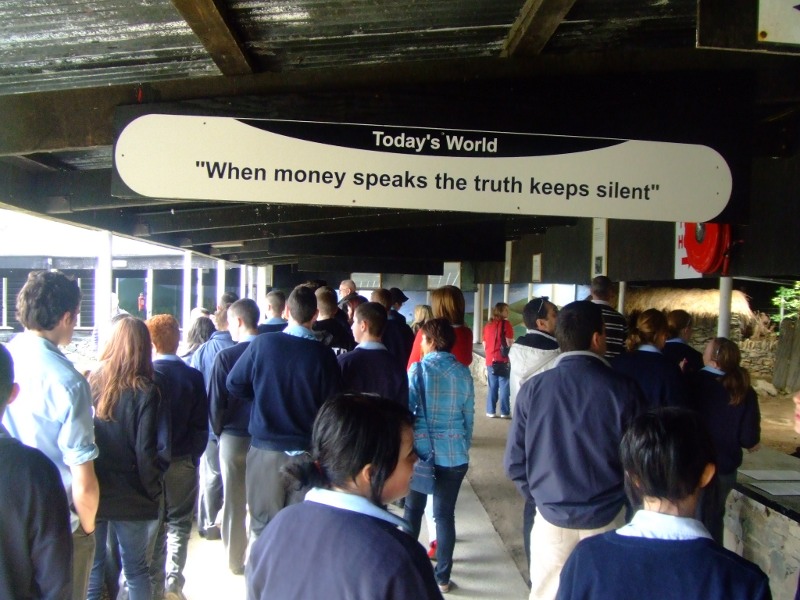
With that in mind, a poster was designed for the school library (see above). Literacy skills do not come easily to a lot of young people and we felt it was necessary to introduce a little incentive to the equation…Money...Of course, that got their attention! We wanted to enforce the concept that reading and writing are not "what nerds do in their bedrooms because they’re no good at football"...reading and writing are life skills and are certainly worth the effort!
While we’d like it to be the case that pupils would read and write with enthusiasm all the time, that’s just not going to happen. Literacy skills must be nurtured, enforced if necessary, until they become second nature. That’s our responsibility as teachers and librarians. Once the groundwork has been done, pupils who would ordinarily struggled with the concept of literacy as a pastime might then be encouraged to embrace reading and writing as pursuits to be enjoyed.
We highlighted the achievements of Booker Prizewinner, John Banville, author of "The Sea". We wanted to convince our pupils that they don't have to be born gifted, or with a book in their hand to be successful in the world of literature. John Banville is an ordinary man from an ordinary background who developed a love for literature, and continues that development every day. It's paid off big time!
Life & Biography / Vida y Biografía Also known as….. También conocido como…. Where was Shakespeare born? ¿ Dónde nació? How many children did he have? ¿Dónde vivió? Time when he lived? ¿Época en la que vivió? Who did he marry? Un hecho llamativo de su vida. A strange profession he had? Un trabajo extraño que desempeñó…
Works / Obras How many sonnets did he write? ¿Qué son los entremeses? How many plays did he write? ¿Qué géneros literarios escribió Cervantes? Translate these well-known plays: Sueño de una noche de verano
Mucho ruido y pocas nueces
El mercader de Venecia
¿Quién no pertenece al Siglo de Oro español? Reinados: Felipe II, Carlos V, Felipe IV, Fernando VII, Literatura: Góngora, Berceo, Quevedo, Calderón, Pintores: El Greco, Zurbarán, Goya, Velázquez
Empareja los personajes con la idea que representan D. Quijote Dulcinea Sancho Panza
La libertad, el ideal perfección, el materialismo
Language & technique / Lengua y simbolismo
How many words did he use in his Works? ¿Qué aspectos sociales ensalza y cuáles critica?
How many words is he said to have created? Cita un paralelismo entre Cervantes y su personaje del Quijote:
Definitions of language resources: Long speech by one actor alone on the stage Direct address to the audience Words with more than one meaning Unrhymed five-metre verse
Algunos vínculos para más información. Recursos: http://www.worldbookday.com/http://www.todayinliterature.com/stories.asp?Event_Date=4/23/1616http://www-tech.mit.edu/Shakespeare/works.htmlhttp://www.cv81pl.freeserve.co.uk/life.htmhttp://www.online-literature.com/cervantes/don_quixote/ “El corazón tiene rezones que la razón no entiende” “ Ser o no ser, esa es la cuestión”
We love irish music. That's why we have prepared our particular version of 'Danny Boy'. And there is also an english piece 'Scarborough fair', and german music and much more at:
http://www.youtube.com/user/musicalamarina
Nos encanta la música irlandesa. Por eso hemos preparado con los estudiantes de 1º ESO una versión de 'Danny Boy'. Una canción desconocida para ellos hasta hace poco. Hay mucha más música disponible en:
Newspapers sales have been falling for years as more and more readers get their news from the Internet or the many free newspapers. Advertisers have also followed readers to the Internet. Apart from the major advertisers, the number of classified ads has dropped dramatically as more people use specialist classified ad websites. As a result, local and national newspapers are closing.
When newspapers first started Internet editions they tried charging for their content, but readers weren’t prepared to pay. They wanted news on the Internet to be free. Now some newspapers, including The New York Times are going to start charging again. Some specialist online papers such as The Wall Street Journal already have a pay wall, but who will pay for their news when they can still get it free in other places? A lot will depend on the growing use of phones and devices such as the Kindle and the iPad that allow you to read news on the move. It’s possible that newspapers will make a comeback in the future – if they can survive.
Magazines are facing similar problems. Advertising revenue fell by around 22 per cent in 2009; consumers often stop buying magazines in times of economic cutbacks. Magazine publishers are hoping to fight back with their own version of the iTunes store where magazines can be downloaded.
Book publishers are trying to predict the future. Will we still be reading printed books in the future or will we be downloading them and reading them on an e-book reader such as Amazon’s Kindle or the iPad?
Some people used to say that reading a book on a computer screen or portable device was tiring for the eyes. But most of today’s e-book readers use a form of virtual ink that makes reading a digital book similar to reading a print book. An e-book reader can also store hundreds of books, making it a portable library.
According to one source, Amazon had sold more than 3 million Kindle readers by the end of 2009, and analysts forecast that Apple will sell 4 million iPads by the end of 2010. Although the iPad is a multi-function device, one of its primary uses is for reading books and newspapers. Apple is creating its own iBookstore to sell digital books and compete with Amazon.
The rise of the digital book isn’t good news for printers and bookshops. As more businesses close, the future of the traditional print book must come into question.
While recently browsing through a shelf of books politely described as “the great unread” section in Carndonagh CS library, a very well-read colleague discovered what might be considered the find of the century (as far as Carndonagh Community School library is concerned anyway!)
In amongst the tattered textbooks and mishandled novels was found an inconspicuous little volume entitled “Phases of Irish History” by Eoin MacNeill.
A first edition printed in 1919, the book itself appears unremarkable and would understandably be overlooked by the average reader and…ahem…librarian! While the age of the book does not immediately draw attention (we have a number of books from the 1800s), the year of its publication, when considering the author, is particularly significant. On 21st January 1919, the First Dáil (the unofficial Government of Ireland, in which MacNeill himself was a Minister) met in Dublin to approve a Declaration of Independence from the United Kingdom. On the same day, violent events elsewhere in the country signalled the beginning of the Irish War of Independence against the Crown. The subject of the book is ancient Irish history, but the book itself is in effect a snapshot of its time; a time when the author was an integral part of what would become the defining moments of our country's long and tormented evolution.
While the find may be worth something in the region of €500 to a collector (possibly a lot more in 2019!), it is invaluable to the school library collection; it’s a little piece of our history that we are honoured to have. Who knows what little gems may be hiding among the overlooked textbooks in your school...
“The end of eternity” is one of my favourite books. It’s a science-fiction novel which is maybe the kind that I like most. The story of this novel, written by Isaac Asimov, is not easy to summarize. It all happens in a so far future time in which there is a secret company called Eternity that can travel forward and backward in time. This company has the mision of preventing disasters that happen in the earth along all the time.
The main character, Andrew Harlan, is a member os Eternity and in one of his misions he met a girl and they fell in love. But the heads of Eternity suspect the girl, so Harlan and her travelled to a far away time where any member of Eternity has never been. People from Eternity think that in that time the humans have evolved to a specie of superhumans who don’t allow time-travelling of Eternity.
The girl stayed in that time to hide from Eternity, while Harlan is still doing his ordinary life but sometime visiting to his girlfriend.
One day the girl was not in the far away time. Harlan came back and discovered that the heads od Eternity had kidnapped her. Harlan threat them to travel to the moment where Eternity was invented and change it producing the end of Eternity. Harlan succeeded in rescuing the girl but they have to escape at the time where Eternity was created. When they were there, the girl confessed that she was actually a superhuman from a far away time, whose mision was causing the end of Eternity. At the begining Harlan wanted to kill the girl but then he chose destroying the Eternity and living a real life with the girl he loved.
Books, magazines, recipes, digital books…Reading is everywhere! Here are some aspect of it :
Related to the genres, we can find a lot of differentkid of books. Some of them follow guidelines or rules, so it is very easy to classify them in a specific genre. But some mix many genres or they dont have any typical structure which prevent us from determinating the genre. The most common genres are the dramatic and the lyrical . But there are also another ones as didactic or epic genre.
Regarding the topics…nowadays the ones which are in, are the crime novels and the black ones. Now it is not the time of romantic stories, it is the time for science and technology.
According to the place where you can go if yo want to find a good book, you only have to go to your nearest library. Maybe you would prefer to do “book-crossing”. This consists of reading a book from somebody who has released it somewhere. When you finish reading it, you only have to put in in the same place where you found it or in a different one. Like this, lot of people can read the same book for free!
In conclusion, reading is something basic to the society. You can learn a lot and have a good time getting away from it all!
Nowadays there are a lot of genres of literature. Epic, lyric, drama, romance, satire, tragedy, comedy, tragicomedy are some of that styles.
There are books for everyone, it's like the colors, and there is a color for each person. If you like movies you can also taste the literature, because in many cases is as a film script. What about you, what's your type of book?
In my case, I don’t have a favorite genre, I like read novels of action, some comedy, especially if it is theater. Although I don’t usually read during the course, now I'm reading a book of cinema, this book is different to any other, because it is a book made by students and teachers of my school.
In my opinion the habit of reading is good, but only if you like what you read and you are not obligated to read.
Most of teenagers don’t usually read because they think it is a waste of time and they could spend it doing something better. However, I am part of the minority of young people who love reading. My mother reads a lot and the same does my brother, so I have been surrounded by books since I was a little girl.
It depends on the number of pages, but I usually read one book each week, or even in a few days if I am enjoying it. But sometimes it is difficult to get them because libraries don’t usually have novelties or strange books, so I have recently bought an ebook in order not to spend so much money in bookshops.
However, despite the obvious advantages of reading, it has also disadvantages: It may become a vice you will have to give up.
My favorite book is “The Ana Franks Dairy”. She is a girl who was born in 1929. She was a Jewish girl who wrote her experiences in a dairy. She died in 1945.
The book tells the story how she and her family were living because the Germany army was searching for them. The dairy had been written since 12th June in 1942 to 1st August 1944. Her family was helped by two family’s friends who gave them food and news. In the book she told that other family was living with them, also a dentist. Ana tells that she was afraid. Every day she heard the bombs and the shooting of the S.S. On August 1944, the German police (Gestapo) , discovered the two families and the dentist because somebody told the police where they were. She died in “Bergen-Belsen”, but soon was in “Westerbork” and “Auschwitzen”.
In a bookshop or a library we can find all kind of books, we can get books of many different genres: mystery, adventure, science fiction, non-fiction…Books are a good way to get into in a different reality. The best-selling book is the Bible. I am going to write about reading.
Adventure books are the most sold, recently “Harry potter”, which has 6 parts, and the “Lord of the Rings”, which has three parts, have become two of the most important books in history. Thousands of people have bought these books and their stories have also inspired cinema directors to made films which are very successful.
Most of the people like reading. There are different reasons for reading. First, books are cheap, the prize of a book is around 10-15 euros, and you can keep it all your life. Also people love reading because, while you are reading, you enter to a different world, it does not matter the type of book, and you can escape of your problems and get away from it all.
In conclusion, I think that reading is a great hobby. I prefer adventure books but I science fiction books are great too. I think that everybody should read two or three books each year.
"Annie" has travelled around the five continents, "Annie" has crossed oceans and "Annie" has visited a lot of countries and monuments. It may sound amazing, if we thought about a girl, but it sounds incredible if we think that "Annie" is the tittle of a novel written by Stephan Owen. This story is true and it's possible thanks to the "Book-crossing" programme.
Book-lovers can't accept the fact that books are thrown away to the rubbish or simply forgotten in a library, so they have done something to avoid this situation. They have created a programme in which people can exchange books for free. The book owners just have to "release" the book in a club that has sign. The treat consists of, when somebody has already read the book, the reader has to leave it again but in another club.
I really think that it is a very good way to spread culture. It's free, and you can get books that you can't get in ordinary bookshops
Reading is a really good habit, but are young people conscious of how important and useful it can be for them?
Young people nowadays find reading very boring. What they don’t realise is that it is a really good exercise for their brains. However, it is easier for them to go to the cinema where they don’t have to make any effort to understand what they have in front of their eyes. Another point is how reading can improve your comprehension and your vocabulary. Teenagers usually find problems when it comes to express their ideas or what they know in an exam. They could overcome this problem just by practising reading a little bit everyday.
For these reasons, I think that reading is something really important and isn’t spread enough between young people. Therefore, it should be promoted in high schools with activities that show reading as something funny.
The main kind of books I like reading are fiction books, I enjoy reading it because they have a clear story to tell us, and also they have some side plots which are very interesting. Those books are very easy to read, despite having a lot of things which are not related to the story, while you are reading it you are getting into the story, so you cannot stop.
Other books I got a kick out of are those about the problems of young people because they show problems we are facing. These books are also very easy to read because they use common languages in most of the cases.
To conclude, I do not dedicate my free time to reading because I prefer doing other things but if I had to choose I would choose a fiction book. Unfortunately, those are not chosen to be read at school.
 our competition to create a classroom activity for the summer issue of iT's for Teachers. We have chosen one winner and three runners-up, all of whose activities appear in the summer issue of the print magazine and at the site. The winner will receive a Papyre 6.1 e-book reader.